
Canada’s Economy Rebounds: What Q2 GDP Growth Means for Canadian Manufacturing
Canada’s economy has delivered a little good news.
After a sluggish start to 2026, Canada’s real gross domestic product (GDP) increased 0.8% in the second quarter, equivalent to an annualized growth rate of 3.3%. Statistics Canada also revised first-quarter growth upward to 0.1%, meaning Canada avoided the technical recession that had been a concern earlier this year.
The Canadian manufacturers, the story is more complicated. Behind the headline GDP number is an economy still dealing with tariffs, changing supply chains, higher input costs and an increasingly competitive global marketplace. That is where Canadian manufacturing has an opportunity.
The Canadian Economy Is Showing Some Muscle
The second quarter brought a meaningful improvement in economic activity. Canadian exports increased 3.6%, their strongest quarterly increase since the first quarter of 2023. Passenger cars and light trucks were a major contributor, with exports increasing 27% as Canadian automotive production recovered from earlier declines. Energy products, metals and industrial machinery also contributed to stronger exports.
Household spending increased 0.8%, while business investment benefited from increased spending on machinery and equipment and engineering structures. In other words, businesses weren’t completely sitting on their wallets waiting for the economic clouds to clear.
Economic growth is ultimately about businesses producing more, investing more and finding ways to become more competitive.
But Manufacturing Still Has Work to Do
The manufacturing sector has been one of the industries feeling the pressure from Canada’s changing trade environment.
Earlier in 2026, Statistics Canada reported that manufacturing output had declined in the first quarter, continuing a period of weakness across several manufacturing industries. Fabricated metal products, machinery, transportation equipment and other manufacturers have been navigating the effects of tariffs and changing North American supply chains.
The good news is that June brought growth in Canadian manufacturing, even while the overall goods-producing sector declined slightly. Statistics Canada reported that manufacturing was among the goods-producing industries contributing to June’s economic growth.
That doesn’t mean the problems are gone. It means Canadian manufacturers are adapting.
Tariffs Are Changing the Manufacturing Equation
The biggest question for many Canadian manufacturers isn’t simply: “How much does it cost to make this?” It is: “How can we make this competitively in Canada?”
That is a very different question. Tariffs can increase the cost of imported components, disrupt established supply chains and make Canadian products more expensive in export markets. Statistics Canada has reported that manufacturers have been delaying investments and dealing with higher input costs as a result of trade uncertainty.
But trade disruption can also force companies to look at their operations differently. Can we manufacture this part closer to home? Can we reduce material waste? Can we eliminate unnecessary handling? Can we automate repetitive welding? Can we produce smaller runs economically? Can we increase output without adding another full-time employee?
Those questions are becoming increasingly important for Canadian manufacturers.
Automation Isn’t Just About Replacing Labour
This is where technology becomes particularly interesting.
Robotic welding and automation aren’t necessarily about replacing people. They are about allowing skilled people to spend more time doing the jobs that actually require human judgment, problem-solving and craftsmanship.
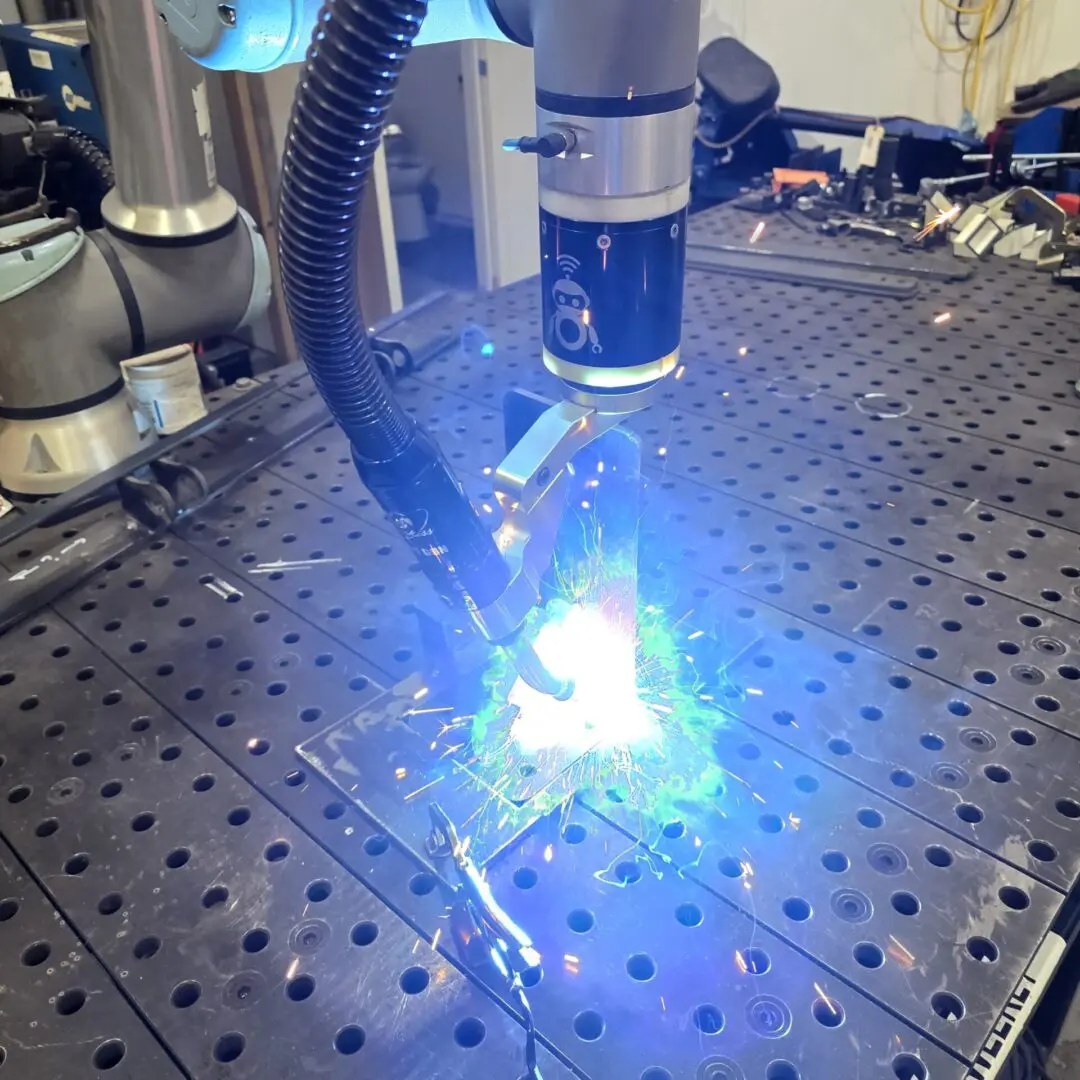
A robotic welding cell can provide consistent welds, repeatability and predictable production times. Once a part has been properly fixtured and programmed, the robot can perform repetitive welding operations while people concentrate on fabrication, quality control, programming, setup and other higher-value work.
For smaller manufacturers, this can be especially valuable.
You don’t necessarily need a million-dollar production line to benefit from automation.
Sometimes the opportunity is much simpler: Take a repetitive welding job and make it faster, more consistent and more economical.
Canadian Manufacturing Needs to Compete on More Than Price
The days of competing solely on the lowest hourly labour rate are becoming increasingly difficult.
Canadian manufacturers have advantages that go beyond labour costs. We have skilled tradespeople. We have engineering and manufacturing expertise. We have access to energy and raw materials. We have proximity to the massive North American market. And increasingly, we have the technology to manufacture smarter.
The challenge is putting those advantages together. Automation, robotic welding, CNC cutting, better fixturing, improved material utilization and lean manufacturing can all help Canadian companies squeeze more productivity from the resources they already have.
What This Means for Manitoba Manufacturers
For Manitoba manufacturers, this is an important time to look at where automation can make a practical difference. Not every job needs a robot. Not every part needs to be automated. But repetitive, high-volume welding is often an excellent candidate. That’s where Plan B Metalworks comes in.
At Plan B Metalworks, we provide robotic welding and metal fabrication services for manufacturers that need additional production capacity without necessarily investing in another robotic welding cell themselves.
Our approach is simple: If you have repetitive welding work, let’s see if we can make it more efficient.
Whether it’s a short production run, overflow work, a new part that needs programming or ongoing production, robotic welding can provide another option for Canadian manufacturers looking to improve productivity and remain competitive.
The Bigger Picture Canada’s second-quarter GDP numbers are encouraging. The economy grew 0.8%, exports strengthened, household spending increased and business investment improved. But nobody in manufacturing should confuse one good quarter with smooth sailing.
Trade policy remains unpredictable. Supply chains continue to evolve. Costs remain important. And Canadian companies still have to compete against manufacturers around the world.
The answer isn’t to simply wait for the economy to get better.
The opportunity is to become better manufacturers.
That means investing in productivity, embracing automation where it makes sense, reducing waste and finding smarter ways to manufacture in Canada. The next few years could be challenging for Canadian manufacturing. They could also be an opportunity to build a more efficient, more automated and more competitive Canadian manufacturing sector.
At Plan B Metalworks, we’re betting on the latter.
Need additional welding capacity?
Plan B Metalworks provides robotic welding and metal fabrication services for manufacturers across Manitoba and beyond.
Have a repetitive welding job? Send it our way.
We’ll see what we can do with it.