
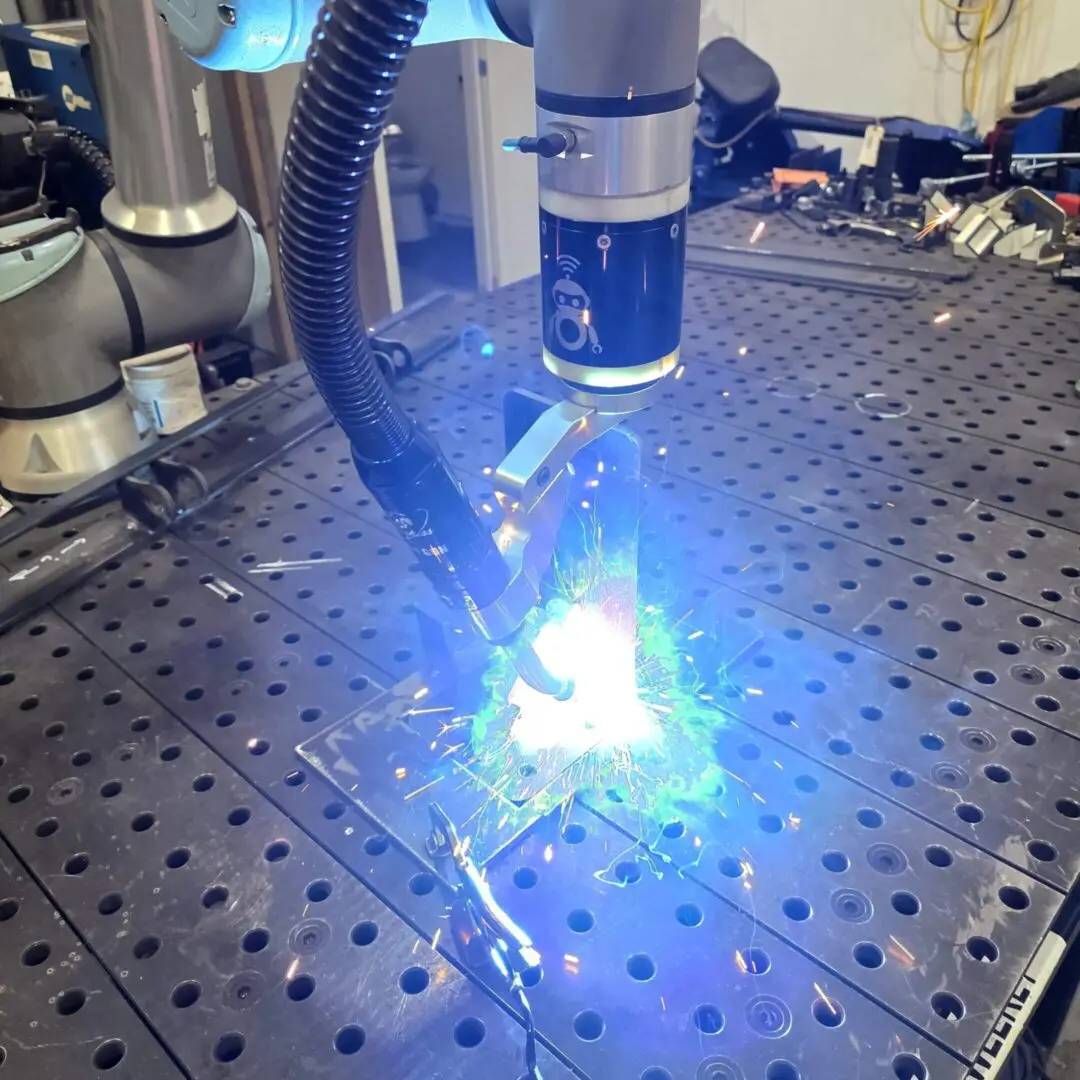
The Learning Curve Is Sharp When Moving to Robotic Welding
If you’ve spent years around manual welding, stepping into robotic welding can feel less like an upgrade and more like moving from a pickup truck into a cockpit full of blinking lights and unforgiving precision.
The destination is faster, cleaner, more consistent production. The first few miles? Steep.
Over the past few years, I’ve spoken with manufacturers who’ve either implemented robotic welding or are seriously considering it. There’s near universal agreement on one point: Robotic welding works.
But the learning curve to unlock real productivity gains is sharp. Why the Learning Curve Feels So Intense.
Transitioning to robotic welding is not just buying equipment. It’s adopting a new manufacturing philosophy. With manual welding, productivity is heavily dependent on individual skill. A great welder can compensate for inconsistent fit up, material variation, or part distortion in real time. Robots do not “figure it out.” They execute.
That means:
Fixtures must be precise
Parts must be repeatable
Tolerances must be controlled
Programming must be intentional
Robotic welding forces operational discipline. And discipline has a way of exposing inefficiencies that were quietly tolerated before.
The Three Phases Most Companies Go Through
1. Excitement
The system arrives. It’s impressive. It’s shiny. The promise of higher arc on time and reduced labour dependency feels within reach.
It is also a positive signal to employees. Investment in automation tells your team the company is thinking long term and planning for the future.
At this stage, everything feels possible.
2. Frustration
Then the rep leaves. The install crew leaves. Training wraps up and reality walks in.
The expectation is that, like any other piece of equipment, it should immediately start making parts quickly.
Cycle times are not what was projected.
Fixturing needs revision upon revision.
Programming takes longer than expected.
You discover that the mistake you made in lines six and seven of the program now needs to change because the fixture was modified. So, you adjust the program. Then something else changes. The loop continues.
Operators who were excited are now learning on the fly while feeling the pressure that this machine needs to run. Mistakes happen.
This is where many companies question the investment. Unfortunately, this is also where some robots get parked. They still get used, but nowhere near their potential.
An industrial robot is built for roughly 80,000 hours of life. That is about ten years at 24/7 production. If the machine is not running, it is not returning on investment. At the ten-year mark, it is both worn and outdated technology.
Underutilization is expensive.
3. Optimization
If you make it past frustration, you enter the real work.
Most manufacturing facilities have deeply ingrained processes. Changing them is incredibly hard. Right, wrong, or backward, these processes feel untouchable. As Jack Welch famously put it, “adapt or die”.
Adding a robot demands process stabilization. The robot will tell you on part one that the way those parts have always been made may not work. Human welders can manipulate angles and fill inconsistencies. Robots execute exactly what they are told.
That precision creates ripples across the operation:
Upstream processes tighten
Fixtures become more robust
Programs are refined
Parts are redesigned with automation in mind
At first, progress feels slow. Then arc on time increases. Throughput climbs. Rework drops.
This is where the gains show up.
The Hidden Advantage of the Sharp Curve
That steep climb creates long term strength. Robotic welding rewards companies that:
Standardize components
Design for manufacturability
Tighten tolerances
Think in continuous flow
Once those systems are in place, productivity does not just improve, it becomes predictable. Predictability allows manufacturers to quote confidently, scale production, and reduce labour risk in a market facing an ongoing skilled trades shortage.
Where Support Matters
For manufacturers producing light industrial brackets, building components, and machinery parts, the real challenge is not whether robotic welding works. It is how quickly you can move from frustration to optimization. A partner with real world robotic welding experience can shorten that climb significantly.
At Plan B Metalworks, we have seen how sharp that curve can be. We have also seen how much smoother it becomes with the right fixturing strategy, programming mindset, and production planning approach.
Robotic welding is not a silver bullet. It is a powerful tool. And like any powerful tool, it demands respect during the learning phase.
The companies that embrace that curve, rather than avoiding it, are the ones that come out stronger, more disciplined, and more competitive on the other side.