
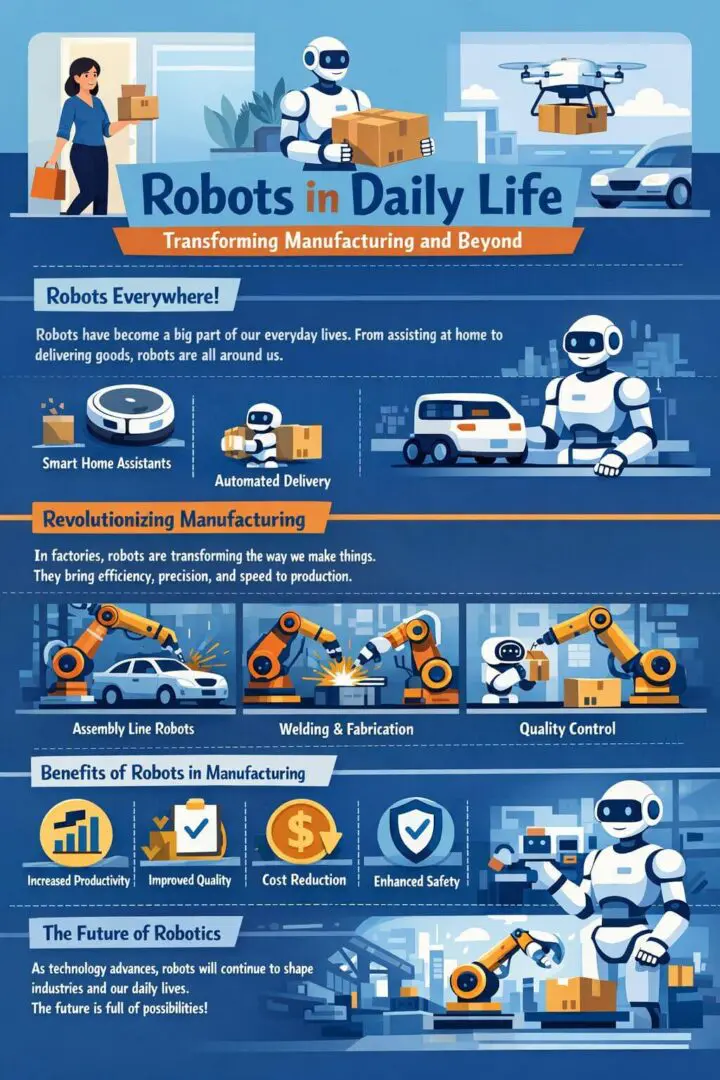
Robots in Daily Life
Robots used to live in science fiction, clanking around chrome corridors and plotting dramatic monologues. Now they live in your house, your phone, your workplace, and occasionally your vacuum cleaner’s existential crisis. The age of robotics is not arriving. It unpacked its suitcase, made coffee, and synced to Wi-Fi.
Robots Are Quietly Becoming Roommates
Most people imagine robots as humanoid machines, but the real revolution is subtler. Modern robots are often invisible or specialized, embedded into systems rather than strutting across floors.
Examples you likely interact with daily:
- Smart assistants that schedule reminders and control lighting
- Delivery automation routing packages with algorithmic precision
- Self-driving features in vehicles adjusting speed and steering
- Customer service bots solving problems before a human even reads the ticket
They rarely announce themselves. They simply make things happen faster, smoother, and with fewer dropped balls.
Manufacturing: Where Robots Shine Brightest
Industrial robotics has become essential because it excels at three things humans naturally struggle with over long periods:
Consistency.
Robots repeat the same motion thousands of times without fatigue or drift.
Precision.
They weld, cut, measure, and assemble with tolerances measured in fractions of millimeters.
Endurance.
They do not slow down on night shifts or Monday mornings.
In welding and fabrication especially, robotic systems produce uniform, high-strength results while reducing material waste and rework. This translates directly into lower costs, faster production cycles, and safer workplaces.
Why Businesses Are Investing Heavily
Companies are not adopting robots because they are trendy. They are doing it because robots solve real operational problems:
- Labor shortages in skilled trades
- Demand for higher production volume
- Pressure for consistent quality
- Safety requirements in hazardous tasks
A robotic system is not just a machine. It is a multiplier. One operator overseeing automation can accomplish what once required an entire crew.
Robots Do Not Replace People. They Redefine Roles
A common fear is that robots eliminate jobs. In reality, they often reshape them. When automation takes over repetitive or dangerous work, people shift into roles involving oversight, programming, maintenance, design, and problem solving.
Think of robots as the new power tools of the workforce. No one accused the electric drill of stealing carpenter jobs. It just made them dramatically more productive.
The Everyday Future Is Already Here
The story of robotics is not about a distant future takeover. It is about a quiet integration happening right now. From the warehouse to the living room to the factory floor, robots are becoming infrastructure rather than novelty.
The real question is not whether robots will be part of daily life. It is how creatively we choose to use them.